


NEMESI STUDIO
Architetti
07.02.10
UNETERNAL CITY
TRANCITY
TRANCITY
Emerging field: la città-infrastruttura - Empty field: la città-parco
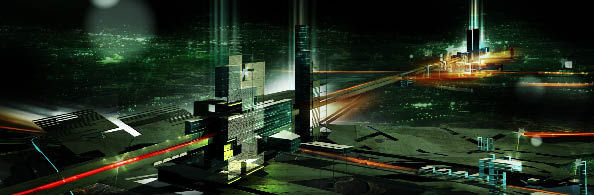
Trancity è immagine di una città-non città, che supera la figuratività dell'urbanistica tradizionale - l'architettura della città disegnata - e le modalità caotiche ed auto clonanti con cui la metropoli contemporanea aggredisce e divora il territorio imponendo la dittatura del pieno (sprawl urbano che invade e consuma lo spazio pubblico / figure e volumi che dominano sul fondo).
Trancity nasce da un'inversione radicale di queste dinamiche, mirando al riscatto del vuoto da una condizione di marginalità, facendolo così assurgere a nuovo sistema figurativo. Nasce il tema della città-paesaggio che in opposizione al tema del tradizionale tessuto-figura e alla ripetitività delle volumetrie analoghe e autoclonanti, struttura la propria esistenza sulla negazione di qualsiasi figuratività, restituendo la scena al vuoto e all'assenza come struttura informale ed emergente.
Il tema del vuoto-paesaggio è radicalizzato attraverso due opzioni estreme e complementari:
Emerging field: la città-infrastruttura
La dimensione paesaggistica di Trancity in questa opzione si concretizza nell'invenzione dell'edificio-infrastruttura dallo sviluppo autosimile, che, attraversando lo svolgersi morbido dell'agro romano, evoca l'antropizzazione del paesaggio attraverso i grandi segni infrastrutturali (ferrovia, autostrada, acquedotto, etc.). Nell'area della Magliana, a sud-ovest di Roma, un macrosegno urbano originato dall'asse del Corviale (grande struttura per residenze popolari realizzata negli anni Settanta nella periferia romana per arginare il dilagare dello sprawl), collega quest'ultimo alle arterie infrastrutturali del Grande Raccordo Anulare e dell'autostrada Roma-Fiumicino, dando luogo, nel punto della loro intersezione, alla nuova porta urbana a sud della città; la complessità e la compresenza di funzioni e attrezzature metropolitane vengono unificate in un'unica architettura-infrastruttura, in cui convivono attrezzature pubbliche e private, residenze e attività ricreative, servizi e commercio. A confermare la natura attraversante del grande asse due monorotaie magnetiche percorrono la sommità della nuova città lineare.
Empty field: la città-parco
Il tema della città-parco è espresso dalla scomparsa della figura-volume, che lascia invece la scena alla superficie-parco. Nella grande area pianeggiante posta più a sud, ai margini del fiume Tevere, la città-parco si misura sul tema della texture e della ripetizione auto-simile, sulla metafora dell'allagamento, articolando un paesaggio poroso capace di evocare una dimensione vernacolare. Al di sotto della superficie-parco, un tessuto più minuto, “la casbah”, accoglie residenze, servizi, infrastrutture, coagulo della sommatoria di esperienze individuali e pubbliche, articolando una sorta di città ribaltata. Nelle viscere di questa nuova casbah contemporanea, patii, roof gardens, canali e specchi d'acqua, danno vita ad un organismo urbano di forte intensità, dove la differenza culturale, e di abitudini di vita, trova una propria sintesi collettiva.
La città-infrastruttura e la città-parco sono due volti di un unico sistema in cui l'architettura costruisce nuove risposte all'imprescindibile richiesta di sostenibilità ed autogenerazione dei propri fabbisogni energetici; Trancity è un'architettura che costruisce la propria identità in coerenza e interscambio con il paesaggio naturale e antropizzato che la circonda.
NEMESI STUDIO
TRANCITY
Emerging field: the city-infrastructure - Empty field: the city-park
Trancity is the image of a city-non-city that overtakes the image of the traditional urban design - the architecture of the drawn city - and the chaotic and self-cloning ways with which the contemporary metropolis assaults and lies on the territory, imposing the dictatorship of the fullness (urban sprawl that invades and devours the public space and volume over the top of the background).
Trancity was born from a radical inversion of these dynamics and it is aiming to redeem the emptiness from marginality, in order to become a new figurative system. Trancity proposes the theme of the informal city, in opposition to the classic urban tissue and to the repetitiveness of similar and self-cloning volumes: it bases its existence on the negation of any figure system, giving back the scene to the emptiness as informal and emerging structure.
The theme of the emptiness-view is radicalized by two extreme and complementary options:
Emerging field: the city-infrastructure
In this option the landscaping dimension of Trancity is materialized in the infrastructure-building, with a self-similar development, that through the soft roman countryside, evokes the anthropologism of the natural landscape through big infrastructural signs (railway, motorway, aqueducts, etc). In the Magliana area, southwest of Rome, a macro urban sign created by the Corviale's axis (a big popular building built in the Seventies in the roman outskirts in order to contain the sprawl), connects it to the infrastructural ring-road of the Grande Raccordo Anulare and of the Roma-Fiumicino motorway, generating - where they intersect - a new southern door to Rome; the complexity and the co-presence of functions and urban equipments, are collected in one architecture-infrastructure in which public and private functions live together: housing and recreational activities, public services and business, with the big arterial street that connects horizontally all the parts.
Empty field: the city-park
The theme of the city-park is expressed by the abandonment of the figure-volume, that leaves the scene to the surface-park. In the big flat area, south of Corviale, on the bank of the Tevere, the city-park works on the tissue and on the self-similar repetition, on the flooding metaphor, articulating a porous system able to evoke a vernacular dimension. Underneath the surface-park, there is a more minute texture, “the casbah”, that welcomes residences, functions, infrastructures and it is almost like a clot of individual and public experiences, creating a sort of overturned city. In the bowels of this new contemporary casbah, patios, roof gardens, courses and lakes create a intense urban organism, where difference of cultures and of life's habits find a collective synthesis.
The city-infrastructure and the city-park are two faces of the same system in which architecture builds new answers to the inescapable request of sustainability and energy self-sufficiency. Trancity is an architecture that builds its own identity in coherence and exchange with the natural and human environment.
NEMESI STUDIO
TRANCITY
Lieu émergeant: la ville-infrastructure - Lieu vide: la ville-parc
Trancity est l’image d’une ville non-ville, qui dépasse la figurabilité de l’urbanisme traditionnel - l’architecture de la ville dessinée - et les modalités chaotiques et auto-clonantes avec lesquelles la métropole contemporaine agresse et dévore le territoire, imposant la dictature du tout-plein (étalement urbain qu’envahit et consomme l’espace public / figures et volumes qui dominent sur le fond).
Trancity prend son origine dans l’inversion de ces dynamiques, visant par ce jeu de miroir à l’affranchissement du vide de la condition de marginalité, en l’élevant à un nouveau système figuratif. D’autre part, on restaure le thème de la ville-paysage en opposition avec le thème traditionnel tissu-figure et avec la répétitivité des volumétries analogues et auto-clonantes (urban sprawling), structure sa propre existence sur la négation de la figure, redonnant la scène au vide et à l’absence en tant que structure informelle et émergeante.
Le thème du paysage-vide est radicalisé à travers deux options extrêmes et complémentaires :
Lieu émergeant: la ville-infrastructure
La dimension paysagiste de Trancity se concrétise par l’invention du bâtiment-infrastructure au développement auto-similaire, lequel, à travers le développement douce de la campagne romaine, évoque l’anthropisation du paysage, rythmé par de grands signes infrastructurels (réseau ferroviaire, autoroute, aqueducts, etc.) Dans la zone de la Magliana, au sud-ouest de Rome, un macrosigne urbain engendré par l’axe du Corviale (grande structure de résidence sociale réalisée pendant les années 1970 dans la périphérie romaine pour endiguer l’étalement urbain), connecte ce dernier à l’artère infrastructurelle du Grande Raccordo Anulare et à l’autoroute Roma-Fiumicino, générant à leur point d’intersection une nouvelle porte urbaine dans le sud de la ville; la complexité et la présence de foncions et équipements métropolitaines viennent unifiés en une seule architecture-infrastructure, où équipements publiques et privés, résidences et activités récréatives, services et commerces coexistent. Conformément à la nature traversante du grand axe, deux monorails magnétiques parcourent la sommité de la nouvelle ville linéaire.
Lieu vide: la ville-parc
Le thème de la ville-parc est exprimé à travers l’élimination de la figure-volume, qui laisse la scène à la surface-parc. Dans la grande zone plane située plus au sud, sur les rives du Tibre, la ville-parc se mesure avec le thème de la texture et de la répétition auto-similaire, suivant la métaphore de l’élargissement, articulant un paysage poreux capable d’évoquer une dimension vernaculaire. Sous la surface-parc, un tissu plus petit, évoquant “la casbah“, accueille résidences, services, infrastructures, addition d’expériences individuelles et publiques, articulant une sorte de ville renversée. Dans les viscères de cette nouvelle casbah contemporaine, prés, jardins suspendus, canaux et miroirs d’eaux donnent vie à un organisme urbain de forte intensité, où la différence culturel et d’habitudes de vie trouvent une propre synthèse collective.
La ville-infrastructure et la ville-parc sont les deux faces d’une même pièce, d’un même système où l’architecture propose des réponses inédites à la demande impérative de limitation de consommation et de l’auto-génération des propres besoins énergétiques; une architecture qui distribue, dispose, construit sa propre identité en cohérence et inter-échange avec le paysage naturel et atrophié qui l’entoure.
NEMESI STUDIO